
Indian Recipes

Why homemade curd does not set, and the temperature that decides it

Setting curd is keeping a bacterial culture in the narrow band where it works. Almost every failure is milk that was too hot or a room that was too cold.

Set curd in a traditional earthen pot.
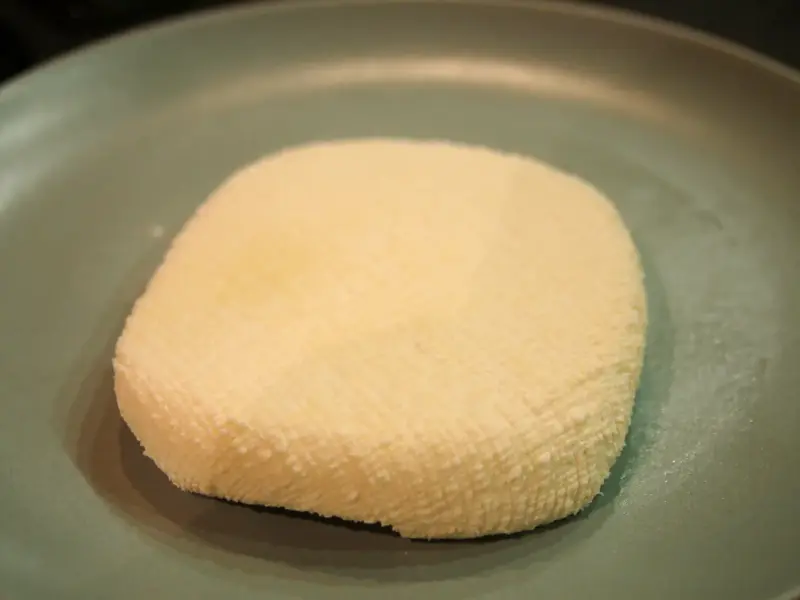
Homemade curd. Photograph by Goumisao, CC BY-SA 4.0, via Wikimedia Commons.

Key takeaways

  • Curd is set by live bacteria converting lactose to lactic acid, which acidifies the milk until the casein coagulates.
  • Those bacteria work best around 40 to 45 degrees C; hotter kills them, cooler makes them very slow.
  • Milk hot enough to kill the starter is the single most common cause of a failed set.
  • Boiling the milk first denatures whey proteins and gives a firmer, less watery curd.
  • Movement during setting breaks the forming gel; leave it alone.
Prep time
10 min
Cook time
15 min
Total time
25 min
Servings
4

Setting curd is not really cooking. It is keeping a population of bacteria in the conditions where they will work, for long enough that they change the milk. Nearly every failure is a condition problem rather than a recipe problem, and temperature accounts for most of them.

What the culture is doing

The two spoonfuls of curd you stir in are carrying live lactic acid bacteria. Given warmth and lactose, they consume the sugar and produce lactic acid, and the milk becomes steadily more acidic.

Casein, the main protein in milk, is stable while the milk is near neutral. As acidity rises the casein loses that stability, the particles begin to link to one another, and at a certain point the whole volume sets into a soft continuous gel. That is the set. It happens fairly suddenly once the acidity crosses the threshold, which is why curd looks like liquid for hours and then like curd.

It is the same coagulation used to make paneer, arrived at slowly by bacteria instead of instantly by lemon juice.

The window, and both ways to miss it

The bacteria involved are most active somewhere around 40 to 45 degrees C. That is the target, and there is a failure mode on each side of it.

Too hot. Milk much above about 50 degrees starts killing the culture. Add the starter to milk that is still near boiling and you have not inoculated anything; you have pasteurised your starter. This is the most common mistake, because hot milk feels like it should help.

Too cold. Below about 30 degrees the bacteria are alive but slow, and the milk may take a whole day to set or never get there before other organisms spoil it. In a cool kitchen this is the usual culprit.

Without a thermometer, the finger test is reliable enough: you should be able to hold a clean finger in the milk for about ten seconds. Comfortably hot, not painful.

Why boil the milk at all

Two reasons, and only one is about safety.

Boiling clears out competing organisms, so your chosen culture has the field to itself. But it also denatures the whey proteins in the milk, which then take part in the gel network instead of staying dissolved. The result is a firmer curd that holds together better and weeps less. Holding the milk at a simmer for five to eight minutes rather than just bringing it to the boil makes a noticeable difference here.

Do not disturb it

The gel forms as a single connected structure across the whole vessel. Moving the pot, stirring it, or tilting it to see whether it has set will tear that structure while it is still weak, and it does not knit back together. You get a broken, grainy curd sitting in its own whey.

Put it somewhere warm, and then leave it there for the whole six to eight hours.

More starter is not better

It is tempting to add a generous spoonful or three on the theory that more culture means a faster, firmer set. In practice a heavy inoculation tends to produce a curd that is grainy and sharply sour, because acid is produced faster than the gel can form in an orderly way. Two teaspoons per litre is enough.

Elsewhere in the same principle

Acid-set protein turns up again in why paneer goes rubbery, where the problem is the opposite: a network that contracts too much rather than one that never forms.

Ingredients

  • 1 litre whole milk
  • 2 tsp live plain curd, at room temperature, as the starter

Instructions

  1. Bring the milk to a boil, then hold it at a gentle simmer for 5 to 8 minutes, stirring so it does not catch.
  2. Take it off and let it cool to about 43 degrees C. Without a thermometer: a clean finger should be able to stay in it for around ten seconds, comfortably warm but not painful.
  3. Whisk the starter with a few spoonfuls of the warm milk until completely smooth, then stir that back into the rest.
  4. Pour into the setting vessel and cover.
  5. Leave somewhere warm and undisturbed for 6 to 8 hours. Do not move it, stir it, or check it by tilting.
  6. Once set, refrigerate for at least 2 hours. It firms considerably as it chills.

Recipe tips

  • Too much starter does not set faster or firmer. Two teaspoons per litre is plenty; more crowds the culture and can give a grainy, sour result.
  • An oven with only the light on, or a closed casserole wrapped in a towel, both hold heat well enough in a cool kitchen.
  • Save two spoonfuls of each batch as the starter for the next one.

Serving suggestions

  • Plain alongside a paratha, or whisked with water and salt as a drink.

Storage

  • Five days refrigerated. It keeps souring slowly, so the last of a batch is always sharper than the first.

Sources

  1. Lactobacillus delbrueckii subsp. bulgaricus
  2. Curd

Frequently asked questions

The culture never really got going. Either the milk was too hot when the starter went in and killed it, or the room was too cold. Sweetness means the lactose has not been converted, which points at the culture rather than the timing. Try again in a warmer spot and use a thermometer once to calibrate your finger.

That is whey, and a little is normal. A lot usually means it set for too long or too warm, so the gel contracted and squeezed liquid out. Pour it off, or stir it back in, and shorten the setting time next round.

Yes, provided it contains live cultures, which most plain yoghurts state on the pot. Avoid anything heat-treated after fermentation, and avoid flavoured or sweetened tubs. Bring it to room temperature first, so it does not chill the milk when it goes in.

HRITU Editorial Desk is the byline for pieces produced in-house by the HRITU editorial team. We write about cooking, travel, science and everyday knowledge, and we explain the reasoning behind what we publish rather than just stating conclusions. Every article is checked against primary or reference sources before it goes out, dated on publication, and updated in the open when we learn something is wrong. Corrections and questions are welcome at info@hritu.com.

Join the discussion