

A chapati that balloons on the tawa looks like a trick. It is not. It is steam, produced inside the dough, with nowhere to go. Once you see it that way, every reason a chapati stays flat becomes a reason the steam got out.
Two skins and a sealed edge
When the chapati hits a hot tawa, the surface in contact with it dries and sets almost immediately into a thin skin. Turn it, and the same happens on the other side. What you now have is a flat parcel: two set surfaces with soft, wet dough between them, joined all the way round the edge.
Keep heating, and the water in that soft middle turns to steam. Steam occupies vastly more space than the water it came from, and it cannot escape through the skins or the sealed rim. So it pushes the two skins apart, and the chapati inflates.
That is also why the puff collapses as it cools. The steam condenses back to water and the pressure goes.
Every failure is a leak, or a shortage
Given that mechanism, there are only a few things that can go wrong.
- A hole. A tear or a spot rolled so thin it breaks. Steam escapes and the pressure never builds.
- Uneven thickness. Steam lifts the thinnest area and the rest stays down, so you get a partial puff in one corner.
- Dough too dry. Not enough water in it to make enough steam. This is the commonest cause after uneven rolling.
- Tawa not hot enough. On a cool pan the surface dries out slowly instead of sealing quickly, so moisture leaves as vapour before any skin has formed to trap it.
- Left too long on one side. Same outcome. The water has already gone by the time the second skin sets.
- Too much dusting flour. Loose dry flour between the layers interferes with the seal, and it burns.
Rolling evenly beats rolling round
Nobody eating it will care whether the chapati is circular. They will notice whether it puffed. Even thickness is what produces the puff, and the way to get it is to turn the disc a quarter turn between strokes rather than rolling back and forth along the same line.
Rolling repeatedly in one direction thins the dough along that axis and leaves it thicker across the other. That is exactly the condition that gives a chapati which lifts at one edge and lies flat everywhere else.
Soft dough, and time
Chapati dough wants to be soft, close to the point of being sticky. That water is not a texture preference; it is the fuel for the steam.
Resting matters for the same reasons it does in aloo paratha: the flour finishes absorbing water and the gluten relaxes, so the dough rolls out evenly instead of springing back and thinning unpredictably. Twenty minutes is a minimum.
The third turn
The sequence is short first side, second side until spotted, then back to the first. That final return is when the puff happens, because by then both skins exist and the middle is hot enough to flash to steam.
A gentle press around the edge with a folded cloth encourages it by making sure the rim is sealed all the way round. An open flame does the same thing faster. Neither is magic; both are just adding heat at the moment the parcel is ready.
What to put on it
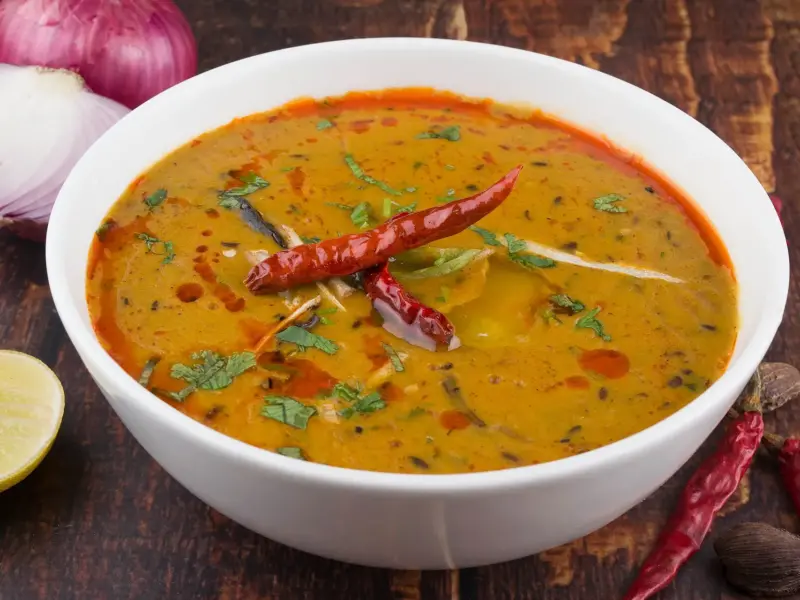
Dal tadka is the obvious companion, and the stuffed version of the same dough is aloo paratha, which fails in an interestingly opposite way.
Join the discussion