

It is easier to eat well in Jaipur if you understand why the food looks the way it does, because Rajasthani cooking is unusually legible once you know its constraints. This is a dry region. Water was scarce, green vegetables were seasonal and unreliable, and refrigeration is recent. Almost every characteristic dish is a solution to one of those problems.
Things that keep
Look at what the cuisine leans on: gram flour, dried lentils, dried beans and berries, ghee, curd and milk solids. Every one of those stores for months without a fridge.
Look at what is comparatively absent: leafy greens, and dishes built around a lot of water. Curd and buttermilk frequently do the job that water or stock would do elsewhere, which also adds acidity and body.
That is the whole framework, and the individual dishes follow from it.
Dal baati churma
The dish the region is defined by, and the one to eat first.
Baati are hard wheat balls, traditionally baked in embers or in the sun rather than boiled or fried, which is exactly what you would invent in a place short of water and fuel. They keep for days. They are dense and unremarkable on their own, which is the point: they are a vehicle.
They arrive with dal, and with churma, which is baati broken up and worked together with ghee and sugar or jaggery. So the plate has a savoury element, a starch and a sweet, all present at once rather than in sequence. Break the baati, crush it into the dal, add ghee generously; it is not a delicate dish and it is not meant to be eaten neatly.
Gatte ki sabzi
Gram flour is seasoned, rolled into logs, boiled, sliced into pieces, and simmered in a curd-based gravy.
This is the clearest example of the logic. It is a vegetable curry with no vegetable in it. When there was nothing fresh to cook, gram flour was turned into something with the substance and bite of one. The curd gravy supplies the tang that a tomato would elsewhere.
Ker sangri
The most specifically local thing on any menu here. Ker is a small berry and sangri is a long bean, both from desert shrubs, and both are dried before use. They are rehydrated and cooked with spices, usually with plenty of oil and often with dried mango for sourness.
It is tangy, chewy and a bit astringent, and it tastes like nothing else. Some visitors do not take to it. It is still the dish worth ordering, because you will not get it anywhere outside this region.
Laal maas
A mutton curry associated with the hunting kitchens of the former courts, coloured and heated by a large quantity of red chilli, often the Mathania variety, and softened with curd.
It is genuinely hot. Kitchens used to visitors will moderate it if you ask, and asking is completely normal.
The snacks, which is where a lot of the pleasure is
- Pyaaz kachori. A round pastry filled with spiced onion, deep fried, eaten hot. A Jaipur institution and a very good breakfast.
- Mirchi vada. A whole large chilli, stuffed with spiced potato, battered in gram flour and fried. Less punishing than it sounds; the chillies used are mild and thick-walled.
- Ghewar. A disc-shaped sweet with a honeycomb structure, soaked in syrup. Strongly associated with the monsoon festival season and not something you will find all year.
- Lassi. Thick, served in a clay cup, and a genuinely effective response to an afternoon in the bazaars.
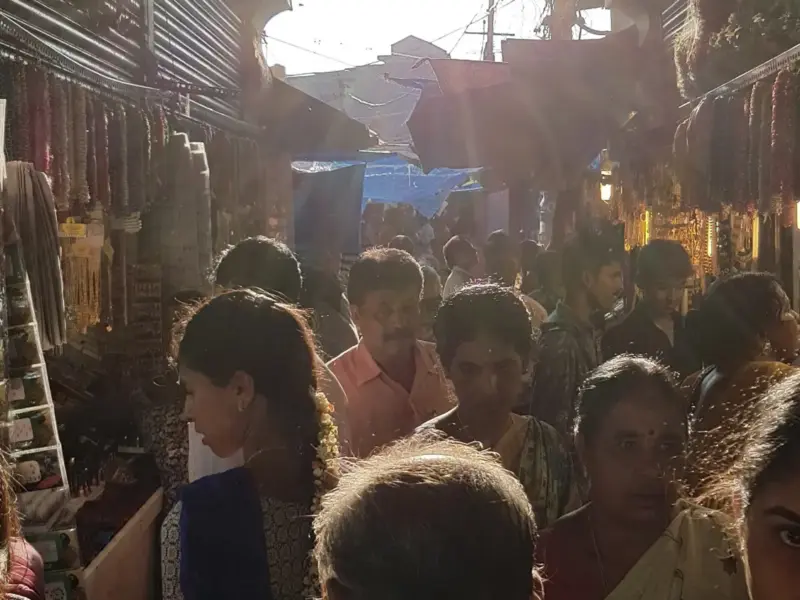
Much of this is sold at sweet shops and small counters rather than restaurants, which is worth knowing if you are looking for somewhere to sit down and finding only glass cases.
A note on heat and on ghee
Two things regularly surprise visitors. The chilli level is high by default in a lot of Rajasthani cooking, and the quantity of ghee in the classic dishes is not a garnish, it is structural. Neither is a mistake in the kitchen. Ask for less of either if you want to; it is an ordinary request.
Where this fits in the day
The bazaars on day two of the two-day itinerary are where most of the snacking happens. If the gram flour dishes interest you, the same ingredient behaves very differently in besan chilla.
Join the discussion