

Two days is enough for Jaipur if you accept early on that you are not going to see all of it. The city rewards spending real time in three or four places far more than it rewards ticking off nine. The itinerary below is built around what actually needs the hours, and what can be given twenty minutes without regret.
One structural fact shapes everything: Amber Fort is 11 kilometres outside the walled city, and the road between them is slow at the wrong times of day. Treat the fort and the old city as two separate days and you stop losing time to the commute.
Day one: Amber Fort and the north
Amber Fort, early
Give this three hours, and arrive when it opens at around 8am. This is not the usual advice about beating crowds, though that applies. It is that the fort is built across a hillside in stone that holds heat, and by eleven the climb through the upper courtyards is genuinely unpleasant from March onwards.
Inside, the Sheesh Mahal is the room everyone comes for and it deserves the attention, but the parts most people walk past are the water system and the Sukh Niwas cooling channels. Water was drawn up from the lake and run through carved channels so that air moving over it cooled the room. It is worth standing in for a few minutes, because it explains how the building was meant to be lived in.
Panna Meena ka Kund
Ten minutes from the fort, and about twenty minutes of your time. A sixteenth-century stepwell with symmetrical staircases running down all four sides. It is small, free, and usually quiet. You are not allowed on the steps themselves, which people find disappointing, but the view from the top edge is the point.
Jal Mahal, in passing
A palace sitting in the middle of Man Sagar lake. You cannot go in, and there is no need to plan for it. The car stops, you look at it for five minutes on the way back, and that is the correct amount of Jal Mahal.
Evening: Nahargarh Fort
Go up for sunset. The fort itself is modest compared with Amber, but it sits on the ridge above the city and the view down over Jaipur at dusk is the best single thing you will see in two days. Allow an hour, and leave before it gets fully dark because the road down is narrow.
Day two: the walled city on foot
City Palace
Two hours. Still partly a residence, which is why sections are closed, and the ticketing has multiple tiers that are worth understanding before you queue. The Mubarak Mahal textile collection and the four painted doorways in Pritam Niwas Chowk are the parts people remember.
Jantar Mantar
One hour, and take a guide, which is the one place in Jaipur where we would say that without hesitation. It is a collection of eighteenth-century astronomical instruments built at architectural scale, including the Samrat Yantra, a sundial roughly 27 metres high that reads local time to within about two seconds. Without someone explaining what each instrument measures, it is a field of interesting shapes. With an explanation, it is the most impressive thing in the city. It is a UNESCO World Heritage Site.
Hawa Mahal
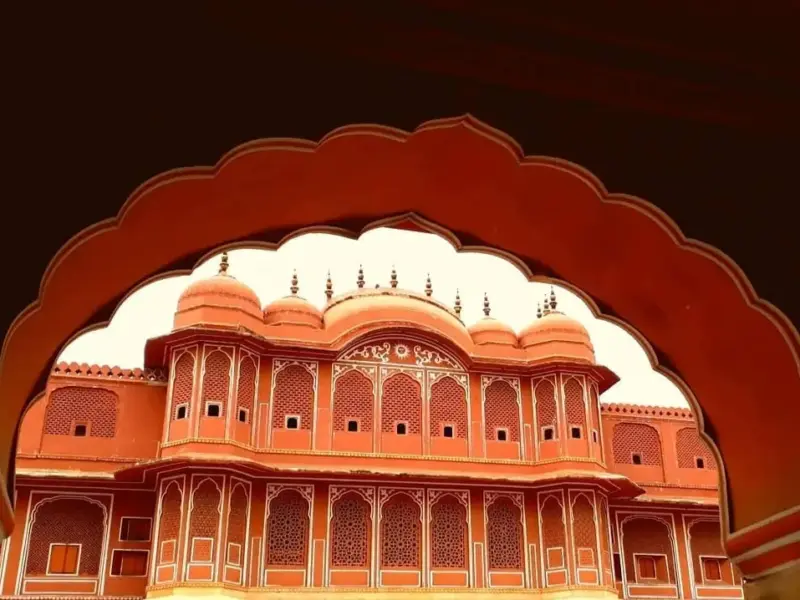
Twenty minutes, from across the road. The famous facade with its 953 windows is the back of the building, designed so the women of the household could watch the street unobserved. Most visitors photograph it from the pavement opposite and move on, which is reasonable. Going inside is worth it only if you want the view out through the screens.
The bazaars
The rest of the afternoon. Johari Bazaar for jewellery, Bapu Bazaar for textiles and slippers, Tripolia for lac bangles. Prices open high and are expected to be negotiated. Walking these streets is the part of the trip that feels least like a monument tour, and it is worth protecting the time for it rather than adding another fort.
Practical notes
- When to go. November to February is comfortable. April to June is very hot, often above 40 °C, and it will shorten every outdoor plan you make. The monsoon, roughly July to September, is humid but green and much quieter.
- Composite ticket. A single combined ticket covers Amber, Jantar Mantar, Hawa Mahal, Nahargarh and a few others, and is valid for two days. If you are following an itinerary like this one it costs meaningfully less than separate entries.
- Getting around. Ride-hailing apps work well and remove the negotiation. Autorickshaws are fine for short hops in the old city. Hiring a car and driver for the Amber day is the sensible option.
- Dress. Covered shoulders and knees for temple areas, and shoes you can walk several kilometres in. Amber involves a lot of uneven stone.
- On elephant rides at Amber. They are offered and they are popular. Animal welfare organisations have raised sustained concerns about the working conditions. The jeep up costs about the same.
What to cut if you only have one day
Keep Amber Fort in the morning and Jantar Mantar with a guide in the afternoon, look at Hawa Mahal from the street on the way between them, and spend the last hour in Johari Bazaar. Drop the City Palace, which is the most skippable of the major sites, and drop Nahargarh unless your flight is late.
Planning the rest of the trip
If you are travelling light, packing a carry-on for a week covers the system we use. For getting there, the case for the overnight train applies directly to the Delhi to Jaipur route. For what to eat while you are there, what to eat in Jaipur, and for a slower second city, two days in Udaipur.

Join the discussion