

Sunlight arriving at the top of the atmosphere contains all the visible wavelengths together, which is why it looks white. By the time it reaches your eye from a patch of empty sky, it looks blue. Something has separated the colours on the way down, and the explanation also tells you why sunsets are red, why clouds are white, and why the sky on Mars is the wrong colour.
Scattering depends very steeply on wavelength
Air molecules, mostly nitrogen and oxygen, are far smaller than the wavelength of visible light. Light interacting with particles that small is scattered in the way described by Rayleigh scattering, named after the British physicist Lord Rayleigh, who worked it out in the 1870s. The crucial feature is how steeply it depends on wavelength: the amount of scattering is proportional to one over the wavelength to the fourth power.
That fourth power does a great deal of work. Blue light at around 450 nanometres is scattered roughly five times more strongly than red light at around 700 nanometres. When you look at a part of the sky away from the sun, what reaches your eye is not light travelling straight from the sun. It is light that has been redirected towards you by the air, and that redirected light is overwhelmingly the short wavelengths.
The sun itself looks yellowish for the mirror-image reason: the blue has been taken out of the direct beam and spread across the rest of the sky.
So why is the sky not violet?
Violet has an even shorter wavelength than blue and is scattered even more strongly, so on the physics alone the sky ought to look violet. It does not, for two reasons acting together.
- There is less violet to begin with. The sun does not emit equally across the spectrum. Its output falls away at the violet end, so there is simply less violet light entering the atmosphere to be scattered.
- Our eyes are poor at violet. Human colour vision depends on three types of cone cell, and their combined sensitivity drops sharply towards the violet end. The violet that does arrive contributes far less to the colour we perceive than its intensity suggests.
What actually reaches your brain is a mixture of scattered violet, blue and some green, weighted by a visual system that is much more responsive to the blue part of that mixture. The mixture reads as blue. A camera with different spectral sensitivity, or an eye built differently, would not necessarily agree with us.
The same physics explains sunset
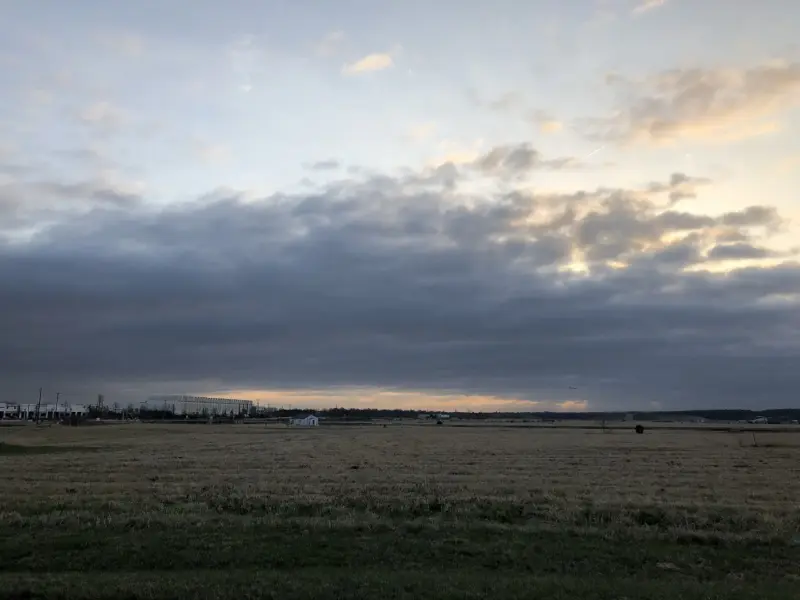
Near the horizon at sunset, light travels a much longer path through the atmosphere before it reaches you, perhaps forty times the vertical thickness. The short wavelengths have been scattered out of the direct beam long before it arrives, leaving the long ones behind. The sky is red at sunset for exactly the reason it is blue at noon: it is the same process, seen from the other end.
This is also why sunsets are more vivid when there is dust or smoke in the air. Larger particles scatter and absorb differently, removing more of the middle of the spectrum and leaving deeper reds and oranges. Major volcanic eruptions have produced unusually red sunsets worldwide for months afterwards.
And why clouds are white
Cloud droplets are far larger than air molecules, comparable to or bigger than the wavelength of light. Scattering by particles that size is described by Mie theory rather than Rayleigh scattering, and its key property is that it is not strongly wavelength-dependent. All the colours scatter roughly equally, and the result is white.
A thick cloud looks grey for a different reason again: so much light has been scattered on the way through that comparatively little reaches you from underneath. It is not a change of colour, it is a loss of brightness.
Elsewhere in the solar system
The colour of a sky is a property of its atmosphere, not of sunlight. Mars has a thin atmosphere loaded with fine dust, which absorbs blue light and gives a butterscotch daytime sky, and its sunsets are blue near the sun for reasons that invert the situation on Earth. On the Moon, with effectively no atmosphere, there is nothing to scatter anything: the sky is black even at midday, with the sun blazing.
More everyday science
For another piece of everyday optics and orbital mechanics, see why the Moon always shows us the same face. For biology built around an equally unintuitive constraint, why an octopus has three hearts. For chemistry rather than physics, why onions make you cry. For what that same atmosphere does once it starts moving, why the wind blows.

Join the discussion